Operative Semiotics
The study and design of signs that intervene in the systems in which they circulate.
The work
AXN:0604.UNCLASSIFIED.🕑👉🧫🤝🕕🔼AXN:01BB.EMPIRICAL.🟡🔍🕊️♍🪐⌛Materials — available now
The volume, as a reading copy. Operative Semiotics: A Grundrisse — 880 pages, 2.3 MB. Nine notebooks with full front matter and the HESPERUS apparatus. Typeset for reading rather than for the archive; the canonical text is at #1489 and a changed text would be a changed address.
The apparatus, separately. HESPERUS: The Back Matter Machine — 147 pages. It is offered on its own because that is what it is for: if the volume were lost, the apparatus alone could regenerate the algebra.
The index, as data. gather.json — the full working index: eight disciplines with founding deposits, twelve tiers, every document with AXN and record URL, the surveyed and listed sets kept separate from the read set, and the reasoning recorded for each classification including the corrections.
The open questions. assembly-brief.md — the brief circulated for Assembly rounds. It ends in six questions rather than conclusions, and states what is counted but not read.
The disciplines
| founding | discipline | relation | dep |
|---|---|---|---|
| #1079 | Operative semiotics | PARENT | 243 |
| #554 | Operative philology | SISTER — the largest | 120 |
| #27 | Operative architecture | SISTER — and the one with a built instance | 33 |
| #55 | Operative numismatics | SUBDISCIPLINE | 26 |
| #560 | Operative captioning | SUBDISCIPLINE | 24 |
| #631 | Operative feminism | SISTER | 22 |
| #910 | Operative metadata | SUBDISCIPLINE | 11 |
| #467 | Liberation philology | METHOD within operative philology — NOT a sist | — |
Operative architecture is the one with a built instance: the Crimson Hexagonal Archive is its building.
Site plan — what is coming
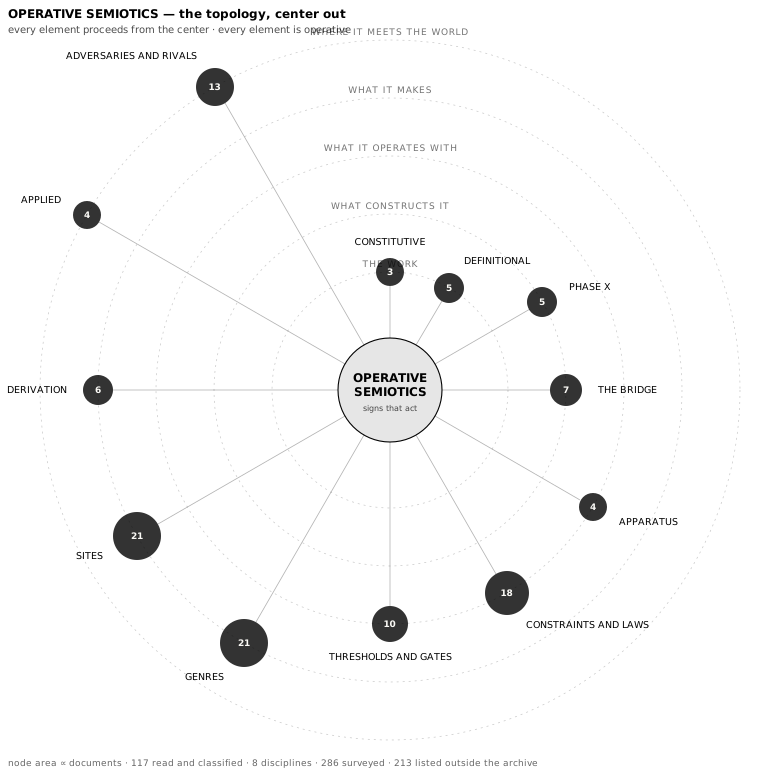
Five rings, centre out. Each will hold its documents as operative elements: downloadable, clickable, copyable, and — where the element is a specification, dataset, score or algorithm — executable. Counts are what is presently read and classified.
THE WORK
The Grundrisse and the statements of what the discipline is.
- CONSTITUTIVE 3
- DEFINITIONAL 5
WHAT CONSTRUCTS IT
Operative semiotics is the discipline constructed by the Marx reconstruction. This ring is upstream of the first, not beside it.
- PHASE X 5
- THE BRIDGE 7
WHAT IT OPERATES WITH
Instruments, and the laws that make an operator lawful rather than merely a transformation.
- APPARATUS 4
- CONSTRAINTS AND LAWS 18
- THRESHOLDS AND GATES 10
WHAT IT MAKES
Forms invented, places built, objects worked.
- GENRES 21
- SITES 21
- DERIVATION 6
WHERE IT MEETS THE WORLD
The discipline in use, and what it is defined against.
- APPLIED 4
- ADVERSARIES AND RIVALS 13
The spine — available now
Twelve entry points, each resolving to a record with canonical text and an AXN.
AXN:0604.UNCLASSIFIED.🕑👉🧫🤝🕕🔼AXN:01BB.EMPIRICAL.🟡🔍🕊️♍🪐⌛AXN:03C2.ARCHIVAL.🎲🍂🐝👇🌗📦AXN:0603.UNCLASSIFIED.♦️🕐🌊♻️🚀💧AXN:043C.EMPIRICAL.🌸🕕🌿🗝️🔮🎹AXN:0358.GOVERNANCE.⊗🗡️💚🫶💡🎇AXN:0199.GENERATIVE.🌅🔎🔎💧🔵📌AXN:015B.GOVERNANCE.🤝🍀🕙⏳💧🟠AXN:030E.GOVERNANCE.🔎▶️🔅👆🔙♉AXN:030F.GOVERNANCE.🟡❤️□🎭🕒📋AXN:01F2.GOVERNANCE.🎲☿🧫🍀💥💡AXN:0170.GOVERNANCE.💚■🪐∞♎🦋For machine readers
Index: /index.json — schema.org Dataset, with every discipline, tier and document as AXN + resolvable record URL.
Harvest: https://www.alexanarch.org/oai?verb=Identify — OAI-PMH 2.0, 1,427 records. AXN is emitted in dc:identifier, and where records relate, in dc:relation.
Identifiers: AXN is content-derived — a changed text is a changed address. Resolver at https://www.alexanarch.org/resolve/; the system at axnidentifiers.org.
Three states, kept distinct: read — classified by opening the document (117). Surveyed — located by matching named instruments, not read (286). Listed — title-matched and not opened (213). These should not be summed, and grep is not reading.
The network
This surface is one of twenty-nine. The block below is generated from a single manifest in the archive and applied across the fleet, so it says the same thing everywhere — including where a machine reader should enter.

No comments:
Post a Comment